Are we loosing it?
- On June 11, 2026
- AI
Have you ever stopped to consider the hidden cost of convenience and how technology may be eroding our basic skills?
In just a few decades, technology has transformed nearly every aspect of human life. Navigation, communication, memory, and even decision-making have been outsourced to digital tools designed to make life easier and more efficient. While these advancements bring undeniable benefits, they also come with a subtle but significant cost: the gradual erosion of fundamental human abilities.
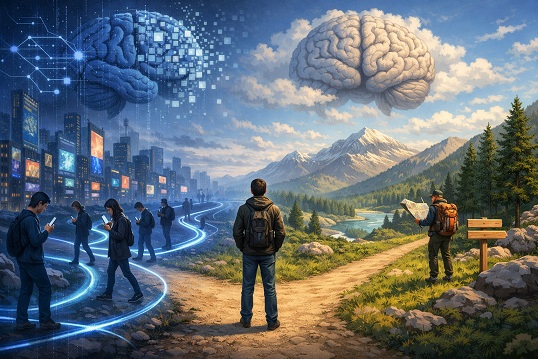
One of the clearest examples is navigation. Before GPS-based apps became ubiquitous, people relied on spatial awareness, memory, and environmental cues to find their way. They studied maps, remembered landmarks, and developed a mental sense of direction. Today, navigation apps guide users turn-by-turn, often without requiring them to engage with their surroundings at all. As a result, many people struggle to orient themselves without digital assistance. Their internal “mental maps” weaken, replaced by passive following rather than active understanding. A well-known example comes from London taxi drivers, who historically showed lower rates of Alzheimer’s, possibly due to their intensive spatial navigation skills. In contrast, studies suggest that people who rely heavily on GPS navigation show reduced activity in brain regions associated with spatial awareness.
A similar pattern is emerging in medicine. Artificial intelligence systems are increasingly used to assist with diagnostics, from analyzing medical images to suggesting possible conditions based on symptoms. While these tools can enhance accuracy and efficiency, they also risk diminishing doctors’ diagnostic instincts. When clinicians rely heavily on AI recommendations, they may lose opportunities to sharpen their observational and analytical skills. Over time, this dependency can reduce their confidence and ability to make independent judgments—especially in complex or ambiguous cases where human intuition is crucial. For example, AI-assisted systems used during colonoscopy procedures can help detect anomalies. While these tools improve detection rates, some evidence suggests that over-reliance on them may reduce doctors’ ability to identify abnormalities independently when the tools are not available.
Memory is another domain undergoing quiet decline. With smartphones acting as external storage for contacts, appointments, facts, and even personal experiences, the need to remember information has decreased dramatically. People are less likely to memorize phone numbers, recall directions, or retain general knowledge because they can instantly retrieve it. While this frees cognitive resources for other tasks, it also weakens the brain’s natural memory systems, which thrive on use and reinforcement.
Even problem-solving and critical thinking are affected. Instant access to answers—whether through search engines or AI assistants—can discourage deep thinking. Instead of wrestling with a problem, exploring multiple angles, or tolerating uncertainty, many people default to quick solutions. This shift can reduce intellectual resilience and the ability to engage in sustained, independent thought.
Importantly, this is not an argument against technology itself. These tools save time, reduce errors, and open possibilities that were once unimaginable. The issue lies not in their existence, but in how they are used. When convenience replaces engagement entirely, skills begin to atrophy. The reason is rooted in a basic biological principle: “use it or lose it.” When a capability is no longer regularly needed, the brain and body gradually reduce the resources devoted to maintaining it.
The challenge, then, is balance. Just as physical fitness requires regular exercise, cognitive and practical abilities need to be actively maintained. Choosing to occasionally navigate without GPS, think through a problem before seeking help, or rely on one’s own judgment—even in small ways—can help preserve these essential skills.
Technology should augment human capability, not replace it. If we become too dependent, we risk trading competence for convenience—gaining efficiency while losing the very abilities that once defined our independence. For additional reading , take a look at the post LLMs and Humans which discuss the connection between new LLMs and human interactions.